MONOPHONIC INSTRUMENT · AN ONDES MARTENOT FOR A KEYBOARD
OM
A monosynth with taste. One listen and you'll swear your finger is strapped into pitch.
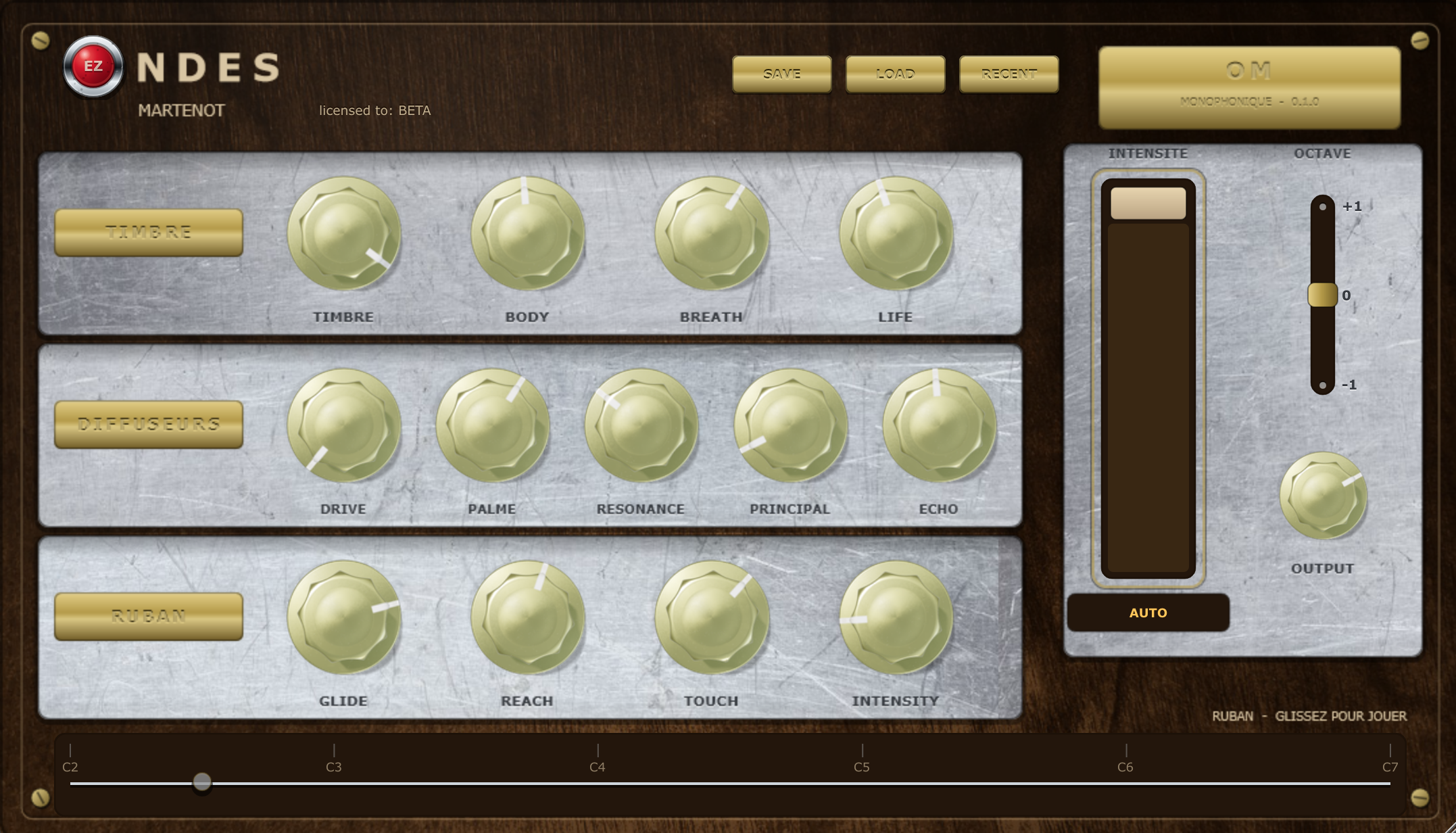
Most Ondes Martenot emulations model the drawbar tones and stop there. OM starts from the three places the real instrument's character actually lives: the pitch that takes time to arrive and never arrives perfectly, the loudness that comes entirely from a pressure key instead of the keyboard, and the speakers — including a lyre with twenty-four sympathetic steel strings — that are part of the instrument, not an afterthought. It glides and slides with the greatest of (MIDI) ease while inventing the sound as it goes, all through a diffuseur bank that behaves like a real spring reverb. A second-order ribbon model gives you portamento overshoot an ordinary synth glide structurally cannot make, and a playable ruban across the bottom of the panel lets you drag for pitch and press down for intensity — playable the right way with nothing but a laptop.
- A virtual ruban: the pitch is a mass-on-a-spring second-order system, not a first-order ramp — it can overshoot and settle back the way a hand actually does
- Touche d'intensite priority chain: panel ruban → channel pressure → CC11 → CC2 → CC1 → AUTO, so it plays properly with or without an expressive controller
- TIMBRE walks a continuous path through five real drawbar colours — O, Creux, Gambe, Nasillard, Particules metalliques — and LIFE makes it wander on its own
- Four diffuseurs modeled from the real cabinets: Palme (24-string sympathetic lyre), Resonance (springs), Principal (drifting 8-line FDN hall), Echo (tape, with wow)
- BODY is an independent resonator axis, separate from TIMBRE's excitation — OFF through PIPE, VIOLIN, CELLO, REED, VOICE A/E, GLASS, METAL
- Automatic vibrato on both pitch and amplitude, arriving late at a definite time — dead straight for the first 0.6s, exactly like a player warming into a held note
VST3
STANDALONE
WIN / MAC
Intro price$25while supplies last
GET OM