LESLIE 122 ROTARY SPEAKER · MODELED AS A MOVING SOUND SOURCE
Rotator
Real geometry, not a modulation trick.
A rotary cabinet built from the physics up, not from an LFO pretending to be one. Every rotor is a moving source on a circle — the same number drives the Doppler and the amplitude, because in a real cabinet the loudest instant is also the least delayed one, and faking that separately is the loudest "this is a plugin" tell there is. Two motors that never share a phase reference drift apart on every speed change, a frequency-dependent horn beams the highs off-axis first, and the bass rotor is a hole in a spinning drum, not a speaker on an arm — so it throbs instead of just swirling.
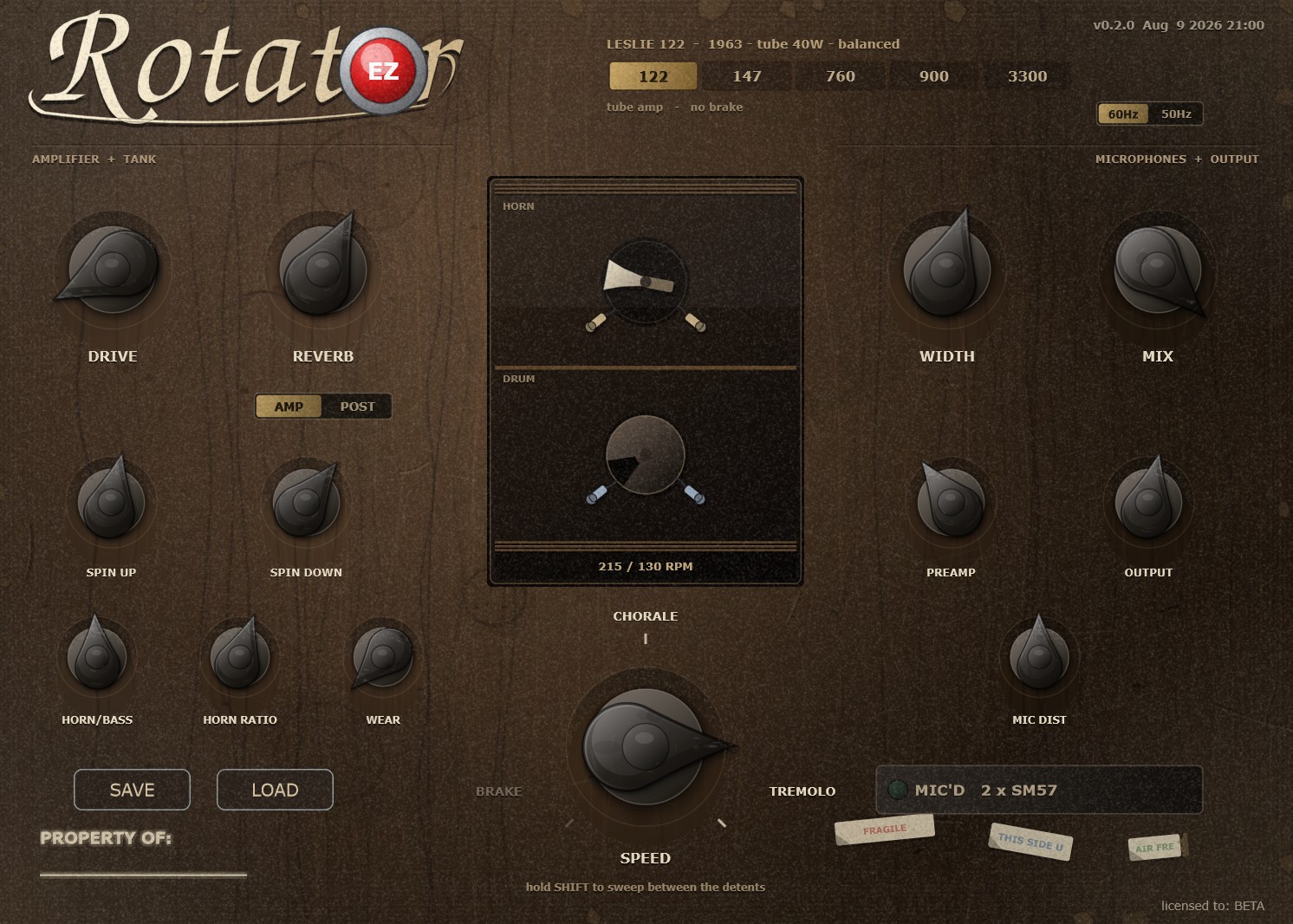
- Five switchable cabinet models — 122, 147, 760, 900, 3300 — each enabling or disabling what the real hardware could actually do: brake, independent rotors, tube vs. solid-state amp
- True per-sample Doppler and amplitude from real source geometry, not the textbook far-field approximation — measured asymmetric spin-up/down and a horn that beams the treble off-axis first
- The bass rotor is modeled as an aperture in a rotating shell, not a source on an arm — sound bends around the drum and arrives late as well as quiet, which is what makes it throb instead of swirl
- Two independent motors with incommensurate periods that drift apart on every speed change — a real cabinet never repeats itself, and neither does this one
- WEAR knob: a mechanically-shaped belt-slip model built from db-cell's chaos generator, so a worn cabinet dips and recovers instead of just sounding detuned
- Two-SM57 mic model with real proximity effect, cardioid off-axis coloring, and an adjustable 0.30–1.80m room — WIDTH actually walks the mics around the cabinet, not just a stereo-width knob
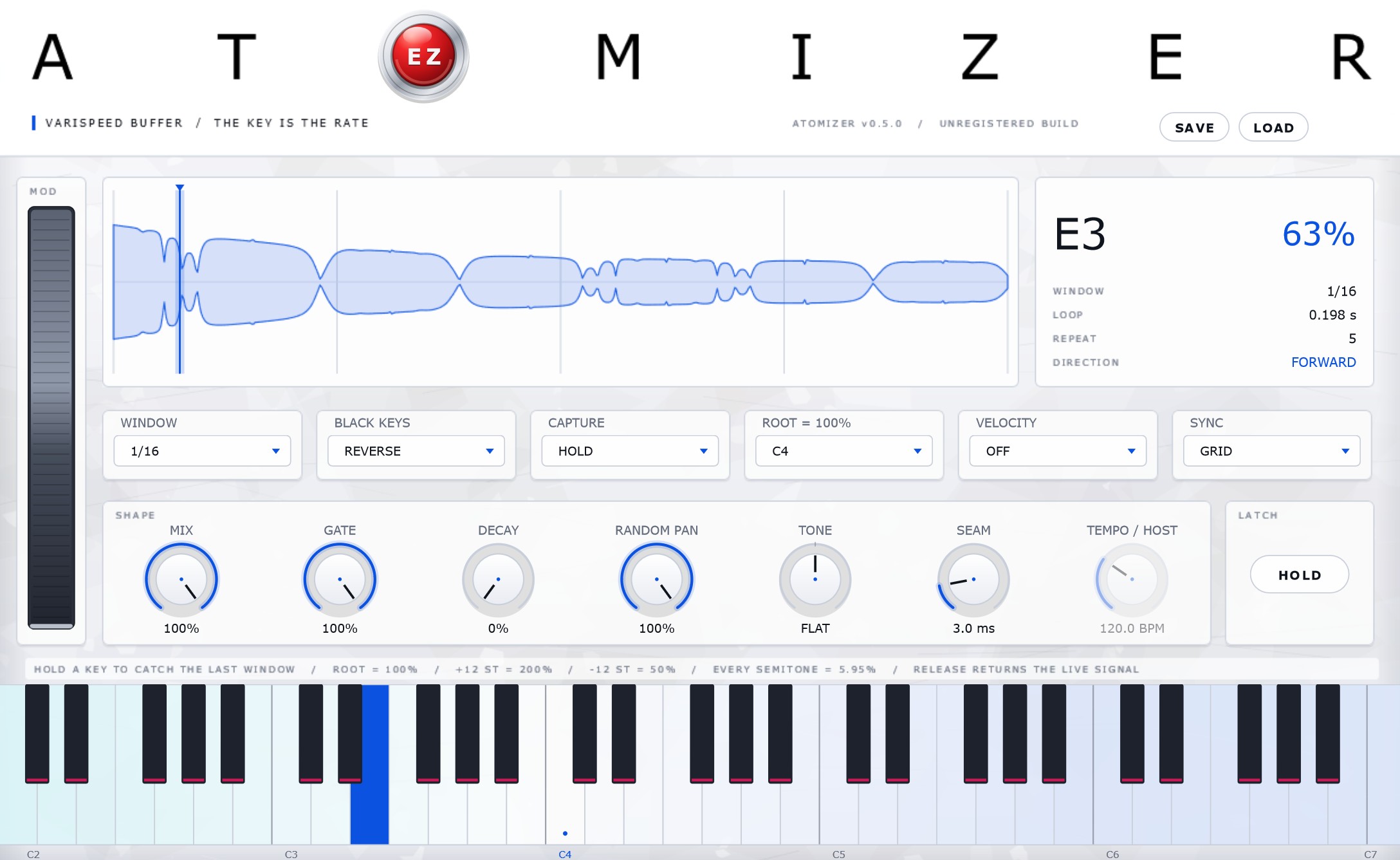
- EZ house button rolls a fresh, musical panel — including the cabinet model — glide capped under a second, never touching MIX or OUTPUT
VST3
AU
STANDALONE
WIN / MAC
NO PRESETS · SPEND TIME WITH IT